In Matai we are very lucky to have Susan Nel come to see us every week on a Wednesday after morning tea. Susan is a certified therapeutic dance teacher using the movement process to help with the physical, emotional, cognitive and social integration of the individual. Susan does this be incorporating the use of music, movement and props in a fun and understanding way that is part of the holistic approach that offers a chance for creative expression for our children supported by our awesome teachers and teacher aids.
Welcome to my professional blog By developing this blog it is an exciting new step on my pathway to gaining my full teaching registration. By using this blog, I am wanting to share my teaching experiences, my personal learning journey, and the school based activities that I am creating for the children in my care. My aim is to make this journey more accessible to my professional colleagues. Stacey
Labels
#Assessment
#Biculturalism
#Leadership
#LearningEnvironment
#LearningProgramme
#ManageDiversity
#ProfessionalDevelopment
#ProfessionalRelationships
#PromotingWellBeing
#SpecialEducation
#TeachingInquiry
#TeachingTechniques
LearningProgramme
professional development
Professional Relationships
Teaching Techniques
Showing posts with label #LearningEnvironment. Show all posts
Friday, 11 September 2015
Monday, 17 August 2015
Syndicate meeting 12/8
During our syndicate meeting last week Norah visited and brought along a bright and colourful bucket and explained that this is a metaphor for filling the buckets of others.
The bucket represents the mental and emotional thoughts and feelings that we have Norah asked us to think about how we feel when our bucket is full and then when it has been drained. This lead me to going online to find out a bit more.
When your bucket is full you feel confident, calm, secure, patient and friendly you will have positive thoughts and you would expect positive results.
And take the time to think about your bucket overflowing there would be a happiness that would spread to those around you and if you received a happy smile or positive feedback or compliment there would be a great big ripple effect.
The bucket represents the mental and emotional thoughts and feelings that we have Norah asked us to think about how we feel when our bucket is full and then when it has been drained. This lead me to going online to find out a bit more.
When your bucket is full you feel confident, calm, secure, patient and friendly you will have positive thoughts and you would expect positive results.
And take the time to think about your bucket overflowing there would be a happiness that would spread to those around you and if you received a happy smile or positive feedback or compliment there would be a great big ripple effect.
Now let's think about if your bucket was drained how would you be feeling there would not be so many positive thoughts and it would be easy to be sad, nervous, insecure, negative, stressed, worried and even possibly physically ill, affecting your behavior and emotions leading you instead to empty the buckets of those around you.
After doing more online reading, I want to think about bucket filling and how my actions and words affect others and not intentionally dipping into the buckets of others.
Sunday, 16 August 2015
Staff meeting 11/8
At this week's staff meeting, we took time again to view and discuss another set of possible questions pertaining to the ERO school visit in week 6. Again we worked in small groups and then shared our findings with the meeting. our questions this time were
What does effective teaching look like for our school?
What does moderation look like in our school?
Again very insightful discussion took place and I have made some notes for my own reference and a collection of answers to these questions over the 2 meetings will be available to us in the near future.
What does effective teaching look like for our school?
What does moderation look like in our school?
Again very insightful discussion took place and I have made some notes for my own reference and a collection of answers to these questions over the 2 meetings will be available to us in the near future.
Thursday, 6 August 2015
6/8 syndicate meeting
Instead of syndicate meeting we had a staff meeting to discuss the upcoming ERO visit and how this might proceed.
In groups we discussed some key questions for our school.
What are the six things you are most proud of at our school?
What defines our school culture?
How do we keep our students safe and manage bullying at James Street School
What are the key aspects of the James Street School curriculum?
Much insightful discussion and sharing happened and recorded for referencing.
Junior syndicate followed the meeting with time spent wrapping rewards for growing great learners.
Saturday, 1 August 2015
Another busy week in Matai
It's Te wiki o Te Reo Maori, Maori language week at James Street School. The theme this year being Whangaihia Nga Matua --- helping parents to pass on Te Reo Maori to their Tamariki.
With expectations for the James Street Tamariki to make and then take home a resource each day to help encourage parents/caregivers to learn and share Te Reo.
And the children in Matai eagerly participated making resources provided by Nat, with fridge magnets and phrase cards going home to celebrate the learning with Whanau
Tuesday, 28 July 2015
Syndicate meeting
For our syndicate meeting this week we discussed the events that prominent in the timetable for the next two weeks. Teachers then discussed their literacy inquiries and brainstormed challenges and solutions in a supportive environment. then as a team we dedicated some time to our professional blogs.
Saturday, 25 July 2015
Staff meeting 21/7
For our staff meeting guided by Ana, we read a 1st chapter copy from the book Learning in the fast lane 8 ways to put all students on the road to academic success by Suzy Pepper Rollins. Having not read this book I am only summarising my thoughts from this copy of the 1st chapter.
In this chapter we deal with the issue of remediation and how this could be hampering our students that are deemed to be the furthest behind (gathered from the many various diagnostic pre-testing that teachers perform routinely) and that it is widening rather than closing the achievement gaps.
Suzy Pepper Rollins an experienced classroom teacher and educational consultant explains her belief that the best way to support struggling students is in the acceleration of their learning. Pepper Rollins goes on to explain her thoughts and how to implement her steps.
Including make standards and learning goals explicit to students i.e. learning intentions (Ana gave us all a copy of How I explain the importance of learning intentions to my class, Barabra Anne Alexander)
Increase students' vocabulary—a key to their academic success; Build students' motivation and self-efficacy so that they become active, optimistic participants in class; Provide rich, timely feedback that enables students to improve when it counts; Address skill and knowledge gaps within the context of new learning.
After our reading, we then participated in a Rubric evaluation of the Effectiveness of classroom teaching practices for students achieving below curriculum expectations in literacy.
Being involved in a discussion at where your peers think their classroom practises and expectations sit within the rubric was interesting and thought provoking.
Friday, 17 July 2015
Term 2 in Matai
It has been in the back of my mind to pick this up and do a post all term it might have been a 11 week term but it been very busy. So 1 thing I've learnt is its planning planning and more planning. Make sure you are planning to the right level, have set learning intentions and that is what you have targeted in your PLANNING, check your resources, be reflective (it goes a long way ) don't over think things sometimes easy to get caught up in over thinking and above all remember to breathe while looking towards to term 3
Thursday, 9 April 2015
Teacher and Teacher aid only day in Matai
Lead by
senior Natalie Williams
We started
the morning with a share of something personal that had special meaning to us our
Taonga our treasure. This gave us an insight to what was dear, important to us
above all; and for all of us it is family they shape us they are there through the
good and bad, we don’t always stay on the same page in our books of life nonetheless
on a whole we are there for them as they are for us.
Term 2 in Matai
Natalie
presented what she envisioned our learning environment to look like for the
second term 2015. Acknowledging and welcoming new staff, discussing general housekeeping
and administration.
We then viewed
concepts to help staff reflect on their own professional practise. Discussion included
no question is a silly question, that we are all learners, our own limiting
beliefs and how we apply these to our children.
Natalie
finished with a statement that I believe was like this (tried to remember it
fully but may have paraphrased a little)
I
have the belief that our children have the amazing ability to surprise us…… however
if we don’t allow them to try then they will never have that opportunity.
After lunch
we participated in a workshop for Anaphylaxis management.
Anaphylaxis –
allergic reactions
These reactions
can happen to anyone at any time but of course are more prominent in someone
who already has a known allergic reaction history.
For a very useful training resource
follow this link
www.allergy.org.au click on Anaphylaxis resources for schools and early childcare to do the training.
During our workshop we were able to view, discuss and participate with the two adrenaline auto injectors the Anapen and the Epipen.
These pens are automatic injectors that administer a single dose of adrenaline.
Adrenaline is the ONLY effective treatment for Anaphylaxis, this is (adrenaline) a hormone that is naturally produced in the human body and is very safe when given in a single dose via an automatic injector. Adrenaline assists with the breathing, maintains heart function and blood pressure works within minutes and last for approximately 10 - 20 minutes, reverses a severe allergic reaction and can be life saving
Anaphylaxis is potentially life threatening and should always be treated as a MEDICAL EMERGENCY.
Monday, 23 March 2015
Ladybirds in Tawa
Introduced the theme of ladybirds with a poem then discussed words to describe what ladybirds look like thinking about colour and what parts they have. Children then drew a ladybird and wrote a simple sentence describing their ladybird.
We then looked at rhyming words for bug ie hug, mug, jug, tug, dug, pug.
For maths we counted how many parts there are to a ladybird ie eyes 2, legs 6, wings 2, body 1, head 1, antennae 2.
Also through out the day we had been making our own ladybirds, which we then added spots starting from 1 to 7, we then used our ladybirds for counting on by counting how many spots on the first wing and counting on with what was on the other wing.
Monday, 16 March 2015
After a warm up of buzz, I used the abacus to revisit 10 and...... (teen facts) as the teacher had explained that the children were quite confident with these facts. We then compared some teen numbers and ty numbers and what they look like on the abacus ie 12 & 20, 13 &30, 14 & 40, 15 & 50.
Jets making connections between finger patterns and sets of objects
10 fingers is the same as 10 bears
7 fingers is the same as 7 beans
3 fingers is the same as 3 dice
10 fingers is the same as 10 bears
7 fingers is the same as 7 beans
3 fingers is the same as 3 dice
Then moving onto
8 fingers is the same as 8 bears is the same as 8 counters on a tens frame
Writing and maths in Rata
While working in Rata and with support from the teacher I had clear ideas and expectations for the writing and maths lessons.
After interval with the children on the mat and the Walt written on the white board (we are learning to start our sentence with a capital letter and read our story so we know what comes next)
I started with My cat likes to..... children brainstormed ideas (ideas recorded these on the white board) so our sentence became My cat likes to sleep in the sun. To enhance the sentence we brainstormed again this time focusing on descriptive words so then our sentence became My big fluffy cat likes to sleep in the sun.
Leaving the Walt in place, children were given two pictures of cats (the higher group were able to work independently) while I work with the others I the mat, where I modeled what was happening in the pictures ie a kitten had found a ball of wool and in the next picture the kitten is tangled in the wool, these children then chose their own prompts and I supported them with the writing process. As I was in this class the following day I was able to get the children to read through their work, reading to see if it made sense,had they used capitals, full stops and spaces between their words.
After interval with the children on the mat and the Walt written on the white board (we are learning to start our sentence with a capital letter and read our story so we know what comes next)
I started with My cat likes to..... children brainstormed ideas (ideas recorded these on the white board) so our sentence became My cat likes to sleep in the sun. To enhance the sentence we brainstormed again this time focusing on descriptive words so then our sentence became My big fluffy cat likes to sleep in the sun.
Leaving the Walt in place, children were given two pictures of cats (the higher group were able to work independently) while I work with the others I the mat, where I modeled what was happening in the pictures ie a kitten had found a ball of wool and in the next picture the kitten is tangled in the wool, these children then chose their own prompts and I supported them with the writing process. As I was in this class the following day I was able to get the children to read through their work, reading to see if it made sense,had they used capitals, full stops and spaces between their words.
Sunday, 15 March 2015
Pirates in Tawa
We started our morning brainstorming what the children thought a pirate looked like or what he/she (no one thought there was any girl pirates) does (this was used to engage prior knowledge). After this was completed I read a poem describing what a pirate is/does from this we we're able to confirm the prior knowledge we had and extend with what we didn't know.
Later I shared Jolly Roger and the treasure (yellow) with the class the children got to colour and decorate their treasure chest and write a simple sentence (modeled and sounded out a simple sentence on the white board).
Later in the day we made our own stuffed pirate
Thursday, 18 December 2014
Art in Kowhai
A busy day based on the book Taniwha by Robyn Kahukiwa with handwriting, shared story, brainstorms, writing and maths lessons we decided we would draw a large Taniwha. All the children helped decide how long and wide we would make our Taniwha,with everyone participating in sketching the outline and how we were going to decorate and add our own patterning to our Taniwha.
Thursday, 27 November 2014
A staff meeting with a difference
The architect came back and presented two different plans for incorporating the special needs unit in a new position within the school. These plans prompted a lot of discussion and have been displayed in the staff room for our feedback, both plans have pro's con's and interesting points which will make it very interesting to see which plan comes to the front.
Thursday, 13 November 2014
Teachings in Rata and Tawa
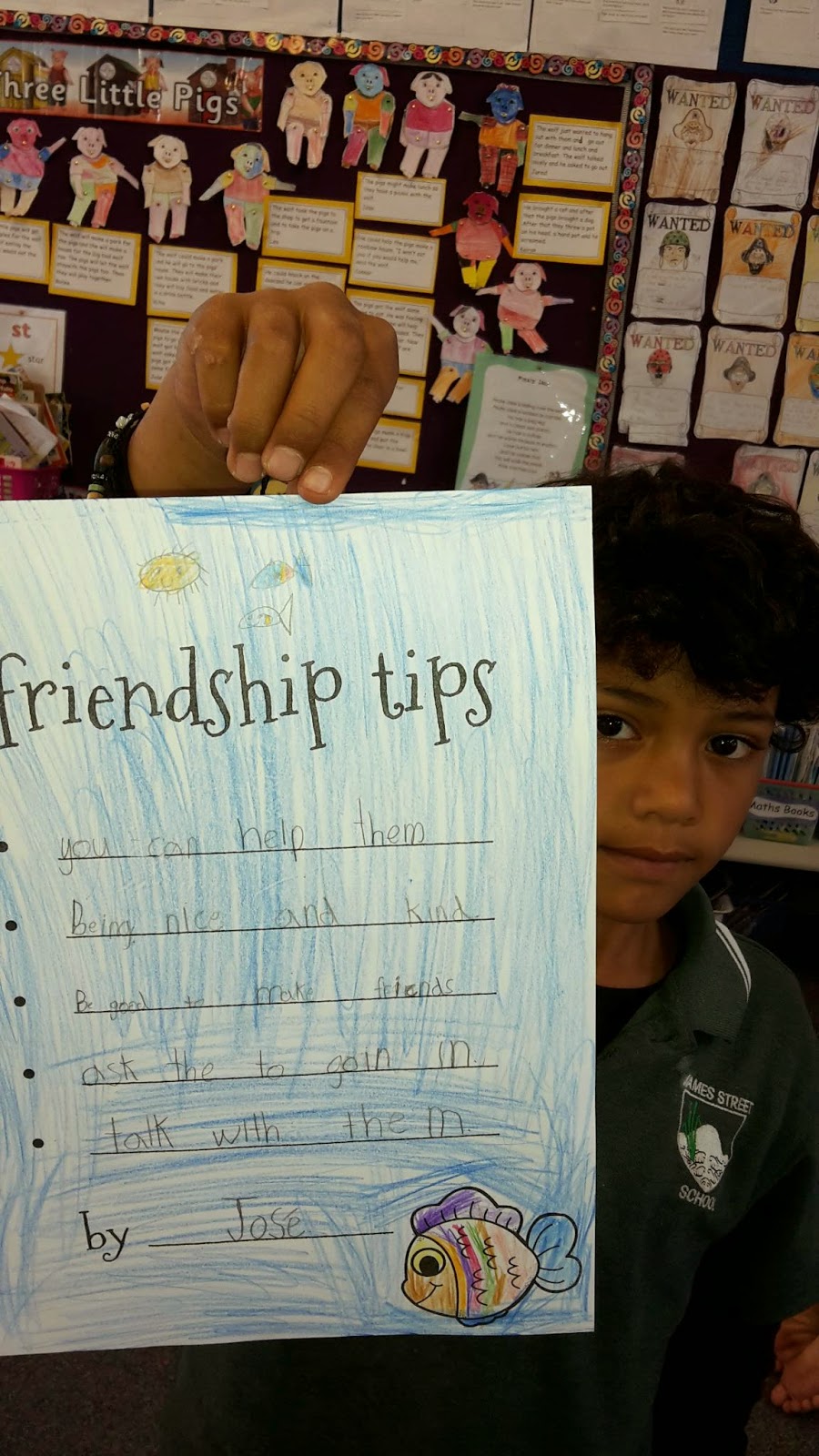
Rainbow fish
While
working in Ruma Rata and later in Tawa at James Street School I wanted to
include lessons that incorporated the strengths of the James Street School PB4L
growing great learner’s programme; we are
Proud, we are Respectful, we are Safe.
Subscribe to:
Posts (Atom)